The programme you hand your members deserves better than a PDF on WhatsApp.
Every gym and every personal trainer knows the same pattern. You sit down, build a programme for someone, write it on paper or in a file, send it over and then silence. You do not know whether they did it. You do not know whether they understood it. You do not know what weights they used, or whether they stopped at the third exercise.
And the next time you see them, the only source of information is their memory.
A programme is not a file, it is a process
A training programme does not end the moment you hand it over. That is where it starts. From that point on you need to know three things:
- what your member's next workout is,
- what they actually did in the previous one,
- and whether they are still going or starting to drift away.
A PDF gives you none of that. A programme that lives inside your app gives you all of it.
How it works in practice
The logic is simple and follows the way you already work:
- You build your exercise library. Every exercise with a description, muscle groups and a photo or demo video, so you never have to explain the same movement for the tenth time.
- You build workouts. Sets, reps, kilos and time per exercise. Once, and then you reuse them across as many members as you like.
- You assign a dated programme. You pick which workouts your member runs and over what period. From there the system works out which one comes next on its own, without you thinking about it every week.
One active programme per member. Clean, with no parallel versions and no "which one was the current one".
What your member sees
They open your app and their next workout is waiting. They hit start, and from then on the workout runs with them:
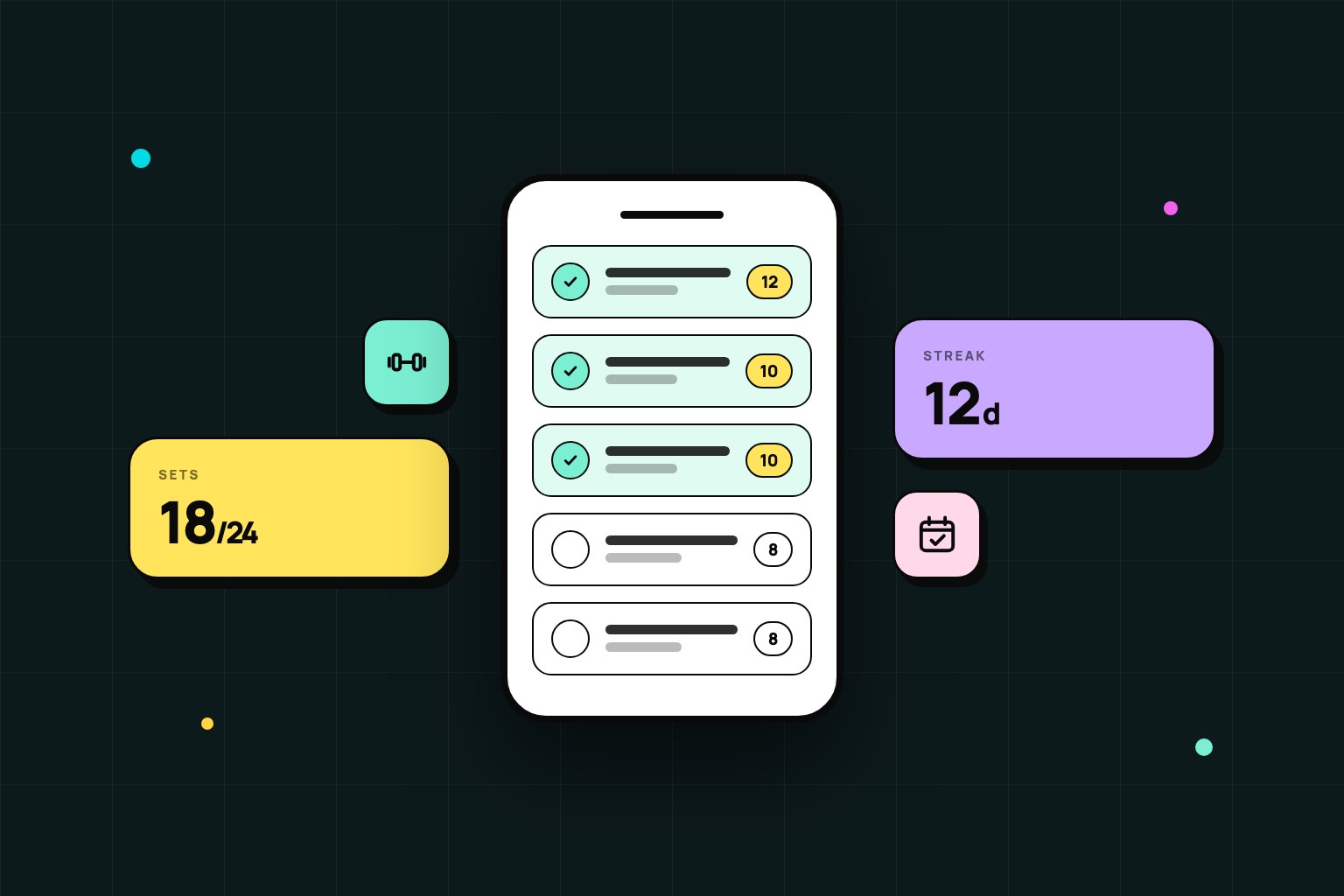
- they tick off each set as they finish it,
- they log the weight they actually lifted, and a note if they need one,
- they pause when they need to, and that time does not count towards the duration,
- they close the phone and come back without losing anything.
And if one day they cannot finish, they can record the workout as partial. Because half a workout is always better information than none.
What you get
The picture you were missing. Every completed workout is written permanently to that member's history and turns into real numbers:
- how many workouts they have completed in this programme,
- their current and best day streak,
- the average duration of their workouts,
- the share of sets they actually finish.
Those numbers change the conversation you have with them. Instead of "how is it going?", you start from "I saw you have been cutting the last sets for two weeks, let's look at that". They also change when you step in: when someone starts drifting, you see it before they stop showing up.
Your work stays yours
The exercise catalogue you have built is an asset, not public material. No member can see it or browse through it. Each person sees only their own programme, through your own account, and only if they are a registered client of yours. None of it is public and none of it leaves your app.
How to start
Not with everything at once. Pick two or three members doing personal sessions, create the ten exercises you use every day anyway, and assign them a one month programme. Within two weeks you will see how different the picture is.
Then the rest follows, gradually. That is how you build a library that serves you for years.
If you want to see how it works with your own programmes and your own members, see what Agento does for gyms or book a demo and we will walk you through it.
The programme you hand over represents your work. It deserves to live somewhere that respects it.